Introduction
Short answer: A solar CRM manages leads and customer conversations. A solar ERP manages company-wide resources such as finance, purchasing, stock and HR. Solar EPC software manages the full project journey, from lead and site survey to quotation, procurement, installation, commissioning and handover. If you sell and install solar systems, EPC software is usually the core system, with accounting connected to it. A CRM alone is often enough if you sell but do not install, and a generic ERP makes sense mainly when finance and multi-department control are your biggest problem.
Most solar business owners do not start by asking which category of software they need. They start with a problem. Leads are sitting in WhatsApp chats. A quotation went out with last month’s panel price. Nobody is sure whether the inverter for Friday’s installation has reached the warehouse. Then a vendor demo begins, and the words CRM, ERP and EPC software get used as if they mean the same thing. They do not.
Choosing the wrong one is expensive in a quiet way. You pay for licences, spend weeks on setup, and your team still drifts back to spreadsheets. This guide explains solar CRM vs solar ERP vs solar EPC software in plain language, so you can match the tool to the way your company really works.
At Kode Karigar, we build Solar EPC Software, so we hear this confusion in almost every conversation with a solar company. We have a point of view, but the goal here is to help you pick the right kind of system, even when the answer is not ours. For a sales-only team, a good CRM is often the better and cheaper choice, and for large groups an ERP is the right backbone.
What is a solar CRM?
CRM stands for customer relationship management. In a solar company, it is the place where sales lives. It captures enquiries from your website, ads, referrals and phone calls, moves each prospect through pipeline stages, reminds your team to follow up, and keeps a record of every conversation.
This matches the general definition: IBM’s overview of CRM describes it as a set of technologies for documenting, tracking and managing relationships with existing and potential customers. Some solar-focused CRMs also add proposal or basic design tools. The common thread is that the CRM is organised around the customer and the deal, not around the physical project.
.
What is a solar ERP?
ERP stands for enterprise resource planning. It connects the back office of a business: accounting, purchasing, inventory, payroll, HR and management reporting. Large groups use it to keep money, materials and people under one controlled system.
An ERP is not built for solar in particular. It is built for companies, of any kind, that need strong financial and operational control across departments. IBM’s ERP guide and Oracle’s ERP guide both describe ERP as software that ties functions such as finance, procurement and supply chain together on shared data.
What is solar EPC software?
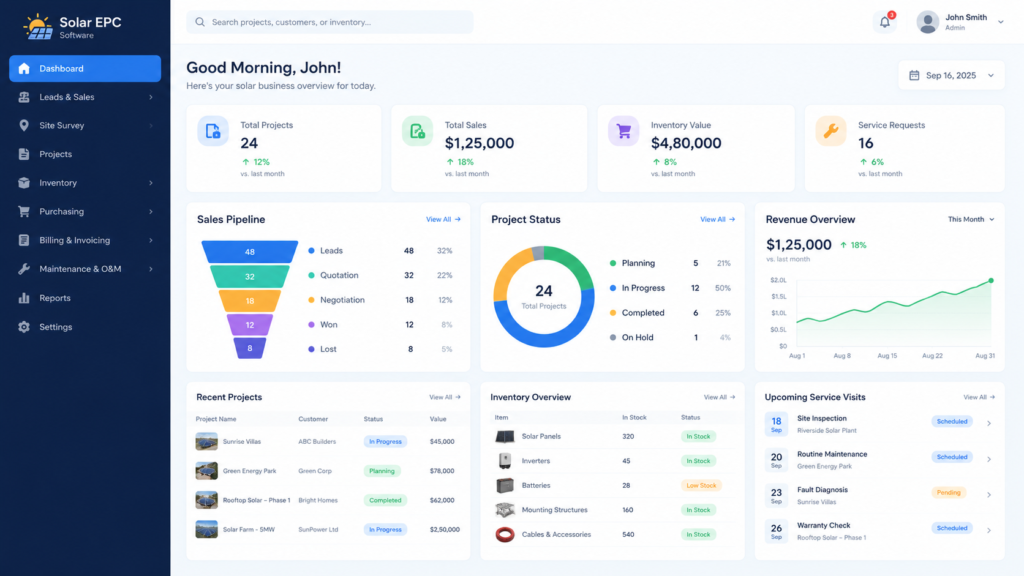
EPC stands for engineering, procurement and construction, which is how most solar projects are actually delivered. Solar EPC software is designed around that journey. A single project record follows the job from the first enquiry through to handover and after-sales service.
It typically covers site surveys, system design and bill of materials, quotations, approval documents, project-linked purchasing and stock, team scheduling, installation progress, commissioning, milestone payments and service requests. Sales is part of it, but the centre of gravity is execution. For utility-scale projects, Berkeley Lab’s Energy I-SPARK describes the same split of responsibilities: the EPC handles engineering and design, procurement, and construction and commissioning. Rooftop and commercial jobs follow the same logic at a smaller scale.
Solar CRM vs solar ERP vs solar EPC software at a glance
| Solar CRM | Solar ERP | Solar EPC software | |
|---|---|---|---|
| Main purpose | Win and manage customers | Run company finance and resources | Deliver solar projects from lead to handover |
| Sales pipeline | Strong | Basic to moderate | Strong, and linked to the project |
| Project execution | Minimal | Generic project modules | Core strength |
| Solar specific workflow | Limited | Needs customisation | Built in |
| Inventory and purchasing | Not covered | Strong | Linked to each project |
| Accounting depth | Not covered | Strong | Basic, or connected to accounting software |
| Setup effort | Light | Heavy | Moderate |
| Best fit | Small sales teams | Large multi department groups | Solar EPC companies and installers |
A CRM stops where the sale ends
Once a customer says yes, a CRM has little to say about what happens next. Site survey dates, material lists, technician schedules and commissioning checks end up in spreadsheets or chat groups. The sales team’s notes never reach the people who install, so details get re-entered, and things get missed.
An ERP does not speak solar out of the box
A generic ERP does not know about system size, string layouts, panel serial numbers or utility approval stages. Teams either pay for heavy customisation or use the ERP only for finance and keep running projects elsewhere. Implementation is also slow, and a mid-sized installer can end up paying for modules it never opens.
EPC software is not a full accounting system
Solar EPC software handles project costs, payments and profitability well, but it does not replace deep accounting, payroll or tax filing. Most companies connect it to the accounting tool they already trust. If a vendor claims to replace everything, ask to see exactly how.
So which one does your solar business need?
The honest answer depends on what you do and how many jobs you run at once. Here is who should choose what:
Choose a CRM if...
You sell solar but subcontract installation. Your priority is lead capture and follow-up, ideally with a CRM that can share job details with your installer.
Choose solar EPC software if...
You install regularly and run several projects at once. Your challenge is no longer finding leads, it is keeping projects moving from survey to handover without losing track.
Choose an ERP, plus EPC software, if...
Solar is one division of a larger group. Use the ERP for group finance and HR, and EPC software for the solar division, connected to each other.
Two other situations come up often:
- You already run an ERP but site teams work in Excel and WhatsApp: add an EPC layer instead of customising the ERP further.
- You are a small team just starting out: keep it simple. A lightweight CRM or a lean EPC tool is enough, as long as you can grow into more.
.
Can you use them together?
Yes, and many well-run solar companies do. A common setup is EPC software for operations and accounting software for the ledger. The trick is deciding early which system owns which data. Customers, quotations and project progress live in the EPC system. Invoices, payments and tax records live in accounting. When both sides agree on that, nobody types the same thing twice.
A quick self check
Answer these honestly for your own company:
- What happens to a lead’s details after the customer says yes?
- Can you see, on one screen, which projects are waiting for survey, approval, material or installation?
- Does your quotation pull from current products and prices?
- Can your site team update progress from the field?
- Do you know the profit of each project, or only the profit of the whole company?
If your only trouble is the first question, a CRM may be enough. If questions two to four are painful, you have a project execution problem, which points to EPC software. If the fifth is your biggest gap, you need cleaner links between projects and accounts.
What to check before you buy
- Ask the vendor to demo one real solar project from enquiry to handover, not a generic sales pipeline.
- Check that site teams can use it on a phone, in the field, without training that takes weeks.
- See how quotations, bill of materials and pricing are handled and updated.
- Confirm you can view profit and progress project by project.
- Ask how it connects with your accounting software, and how existing customer data is imported.
- Check local needs such as currency, VAT, language and the documents your utility asks for, for example in Bahrain and the wider GCC.

Conclusion
The right choice is not the biggest system, it is the one that fixes where your business loses time today. If that is sales follow-up, start with a CRM. If it is company-wide finance control, look at an ERP. If it is keeping installations on track from quotation to handover, you need software built for solar EPC work.
If you would like to see how that looks for a solar company in Bahrain or the wider GCC, you can explore Kode Karigar’s Solar EPC Software or talk to our team about your current workflow.